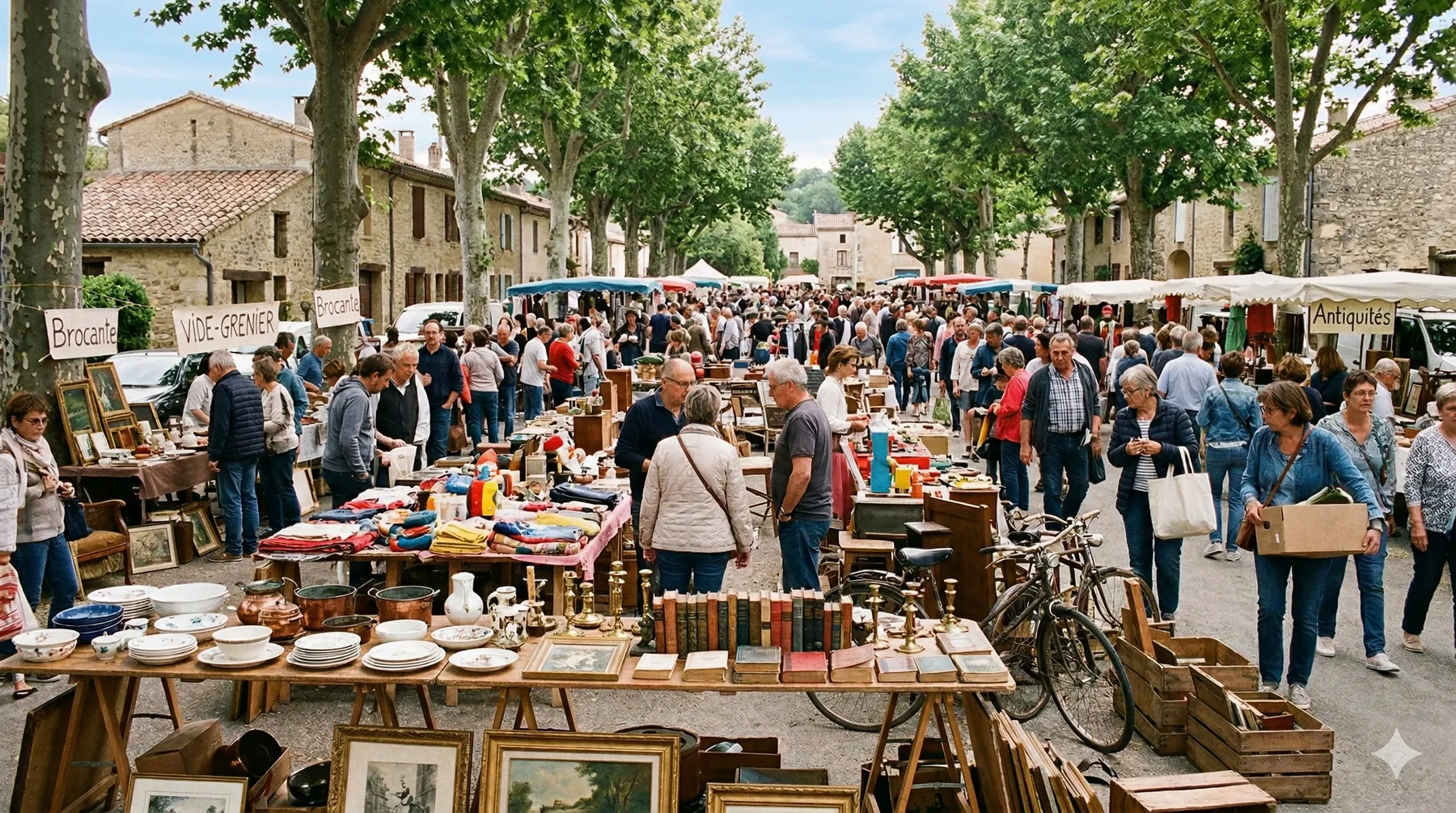
Vide-Grenier de Velaux
Car boot sale by the Comité des Fêtes at the Parc des Quatre Tours, in the hilltop village of Velaux between Aix-en-Provence and the Étang de Berre
About Vide-Grenier Velaux
The Vide-Grenier de Velaux: Friendly Treasure Hunting at the Parc des Quatre Tours
Each year, the Comité des Fêtes de Velaux organizes its car boot sale at the Parc des Quatre Tours, avenue Jean Pallet, a green space at the foot of the eponymous castle. Approximately 150 private sellers display their stalls offering a wide variety of second-hand items: Provençal crockery and ceramics, books and comics, clothing for the whole family, toys, decorative trinkets, small furniture, and all sorts of curiosities. The event, open from 8 am to 4 pm, attracts treasure hunters from Aix-en-Provence, Salon-de-Provence, Vitrolles, and the entire Étang de Berre region.
Velaux, a Hilltop Village between Aix and the Étang de Berre
Located on the hillside, 19 kilometers west of Aix-en-Provence and 33 kilometers north of Marseille, Velaux is an ancient Provençal village with a history dating back to prehistoric times. The commune, now home to nearly 9,000 inhabitants, covers 25 km² between the plain of the Arc river and the foothills of the Arbois plateau, a European Natura 2000 protected area home to Bonelli's eagle and the eagle owl. The village saw significant development from the 1970s onwards, with the construction of the 'new village' on the hill, while retaining its historic core around the medieval Château des Quatre-Tours and the Saint-Trophime church, a partly Romanesque building with a 17th-century Baroque facade and a characteristic dome bell tower.
The Oppidum of Roquepertuse and the Crouching Warriors
The archaeological site of Roquepertuse, classified as a historic monument since 1967, is Velaux's heritage pride. Occupied from the 5th to the 3rd century BC, this Celto-Ligurian oppidum overlooks the Arc valley from a half-hectare plateau. It was here that the famous sculptures of the crouching warriors were discovered in 1824, and then during excavations from 1919 to 1927: two life-size statues representing warriors sitting cross-legged, wearing a tunic and carrying a backplate. These exceptional works of Gallic statuary, accompanied by a bird of prey and a bicephalous head attributed to Hermes, are now housed in the Marseille History Museum. The Roquepertuse site can be visited freely all year round, with interpretive panels and a free audio guide via the izi.TRAVEL app.
The Roquefavour Aqueduct, Visible from Velaux
From the Sainte-Propice botanical trail, one kilometer long and marked with 18 plant species, walkers can enjoy a remarkable panorama of olive groves and, in the distance, the Roquefavour aqueduct. Built between 1841 and 1847 by engineer Jean de Montricher to bring water from the Durance to Marseille, this structure, 393 meters long and 82.65 meters high, is the tallest ashlar stone aqueduct in the world, nearly twice the height of the Pont du Gard. The stone blocks for its construction were partly quarried from two sites in Velaux, transported to the construction site by a 9-kilometer railway built specifically for the occasion. The aqueduct, still in service, supplies Marseille with 80% of its drinking water.
A Day of Treasure Hunting in an Exceptional Heritage Setting
The Velaux car boot sale offers the ideal opportunity to combine treasure hunting and heritage discovery. After browsing the stalls at the Parc des Quatre Tours for bargains, visitors can stroll through the narrow streets of the old village, admire the Baroque facade of the Saint-Trophime church, visit the Musée de la Tour which exhibits archaeological collections from Roquepertuse, or follow the Flâneries circuit, a marked pedestrian route highlighting nine emblematic village sites with descriptive plaques and a downloadable audio guide. The refreshments and fast food, provided by the Comité des Fêtes throughout the day, complete this friendly and family-friendly outing.
Practical Information for Visitors
Velaux is easily accessible from the A7 motorway (Velaux/La Fare-les-Oliviers exit) or by departmental road from Aix-en-Provence. The Parc des Quatre Tours has nearby parking. Entry is free for visitors. It is advisable to arrive early in the morning to find the best bargains, as experienced treasure hunters are present from the opening of the stalls at 8 am. Dogs and motorcycles are not allowed in the park.
Vide-Grenier Velaux — edition 2026
Prices Vide-Grenier Velaux 2026
Practical information — Vide-Grenier Velaux
Practical Information
- Location: Parc des Quatre Tours, avenue Jean Pallet, Velaux (13880)
- Hours: 8 am to 4 pm
- Visitor Entry: Free
- Exhibitors: Approximately 150 stalls
- Food: Refreshments and fast food on-site
- Parking: Near the park
- Access: A7 Motorway, Velaux / La Fare-les-Oliviers exit
- Restrictions: Dogs and motorcycles prohibited in the park
Visitor photos
No photo yet. Share yours!
Share your photos
5 photos max, 5 MB per photo (JPG, PNG, WebP)
Have you spotted an error or missing information?
Help us keep this listing up to date. Every suggestion is reviewed by our team before publication.
Visitor reviews
No rating yet — be the first!
No review yet. Be the first!
Were you there?
Share your experience with the community
Published by Valentin Contard, flea market listings writer. Reviewed, corrected and approved by Christophe Contard, editor-in-chief. .
Where does it take place Vide-Grenier Velaux
Parc des Quatre Tours
Avenue Jean Pallet, 13880 Velaux
Contact
Vide-Grenier Velaux in brief
History
Similar brocantes
Flea market and Country Day by the Cher - Saint-Julien-sur-Cher
Saint-Julien-sur-Cher (41)
02 Aug 2026
Grosrouvre Flea Market
Grosrouvre (78)
07 Jun 2026
Car boot sale of the Centre Bourg of Langon-sur-Cher
Langon-sur-Cher (41)
17 May 2026