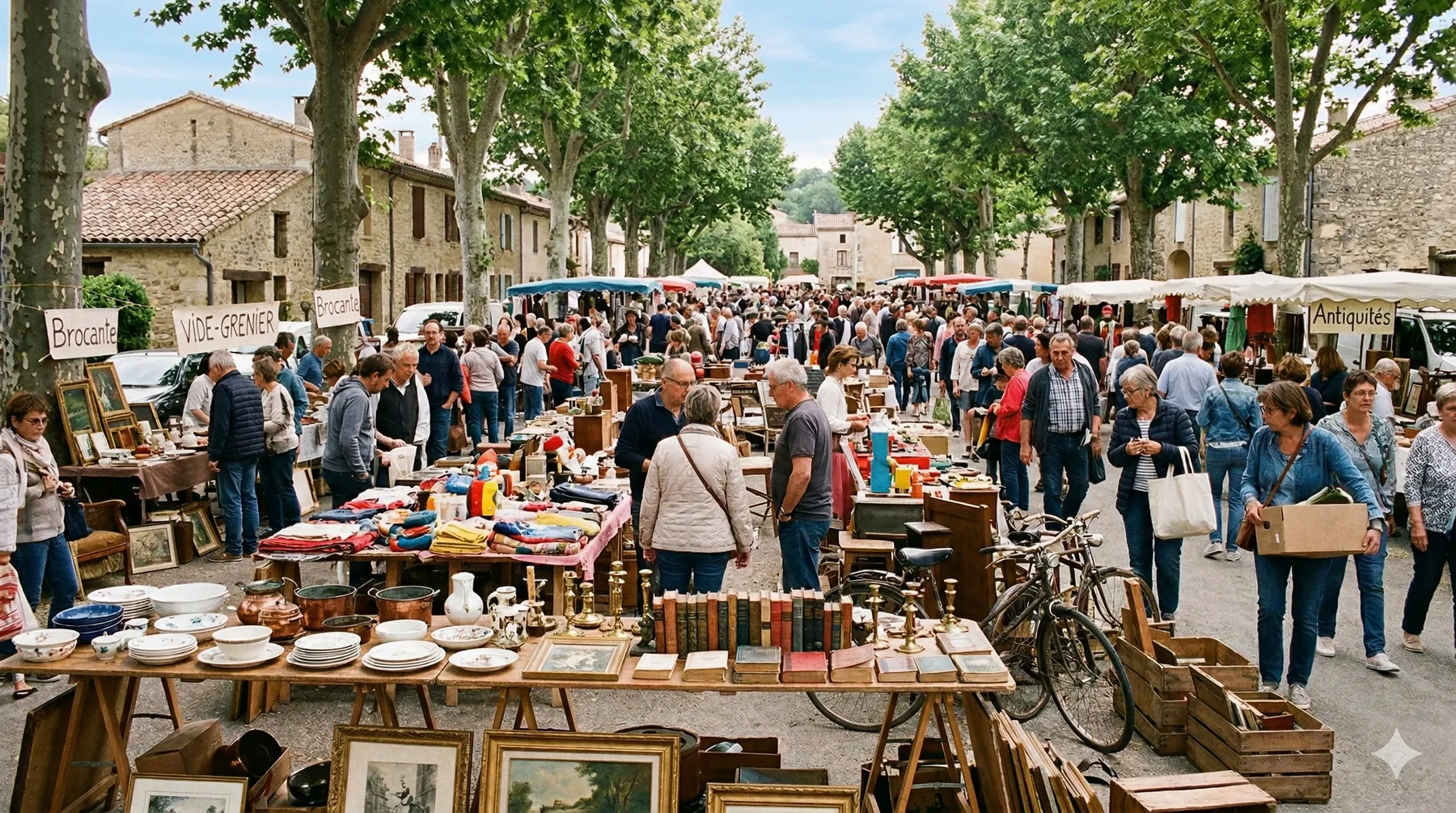
Vide-Grenier de Rognac
Traditional car boot sale on Place Saint-Jacques, by the Étang de Berre in Provence
About Vide-Grenier Rognac
The Vide-Grenier de Rognac: an antique hunting event by the Étang de Berre
Each year, Rognac's Place Saint-Jacques hosts one of the town's two traditional car boot sales. This spring event brings together antique hunters, families, and strollers around stalls run by individuals offering a wide variety of items at low prices: Provençal tableware and ceramics, clothing and accessories, books and comics, toys, small furniture, trinkets, and decorative objects of all kinds. Entry is free for visitors, and the friendly atmosphere typical of car boot sales in the South of France invites you to browse and bargain under the Mediterranean sun.
Rognac, from the Celto-Ligurian oppidum to the Provençal town
The history of Rognac dates back to antiquity. As early as the third millennium BC, sedentary populations occupied the shores of the pond, living from hunting and fishing. In the first millennium BC, a Celto-Ligurian tribe founded a village in the plain and built a castrum at a place called Castellas, a fortified oppidum on a rocky spur overlooking the plain and the pond. Archaeological excavations have revealed a La Tène settlement, prehistoric burials, a calcined ossuary near the Saint-Jacques oratory, and a Gallo-Roman settlement at the foot of Castellas. The very name Rognac could derive from Rudinacum, one of the Roman villas that dotted the territory.
A heritage between pond and hills
Around the year 1000, a seigneurial castle was built at the top of Castellas, and a perched village developed at its foot. In the mid-15th century, the inhabitants left this steep site to settle in the plain, by the edge of the pond. Rognac preserves from this eventful past the Sainte-Marie-Madeleine church, of medieval origin, restored in 1812 after construction ordered in 1664 by the Archbishop of Arles François de Grignan, as well as the Croix de Rognac, a wrought-iron calvary erected before 1881 at the top of the eastern plateau, at an altitude of 270 meters. The Saint-Jacques oratory, located by the pond at the foot of the oppidum, watches over the waters of the Étang de Vaïné.
The Étang de Berre and the Canal de Marseille au Rhône
Rognac extends across an alluvial plain on the edge of the Étang de Vaïné, the eastern part of the vast Étang de Berre, the largest saltwater lake in Europe. This geographical location has profoundly marked the town's identity, focused on water and its associated activities. The Canal de Marseille au Rhône, a navigable waterway connecting the port of Marseille to the Étang de Berre via the famous Rove Tunnel, a monumental structure of over 7 kilometers inaugurated in 1927, testifies to the strategic importance of this passage area between the Mediterranean and the Rhône valley. Collapsed in 1963, the tunnel is now the subject of a reopening project led by GIPREB and the Région Sud.
Antique hunting on Place Saint-Jacques
Place Saint-Jacques, an emblematic site in Rognac located by the pond, offers a pleasant setting for this outdoor antique hunting day. Visitors can combine exploring the car boot sale with a walk along the water, a visit to the old town center, or a hike to the remains of Castellas and the Croix de Rognac overlooking the landscape. Rognac, a commune of over 12,500 inhabitants halfway between Aix-en-Provence and Marseille, benefits from easy access from the A7 motorway and has a train station, facilitating the arrival of antique hunters from the entire Aix-Marseille-Provence metropolitan area.
Vide-Grenier Rognac — edition 2026
Prices Vide-Grenier Rognac 2026
Practical information — Vide-Grenier Rognac
Practical Information
- Location: Place Saint-Jacques, 13340 Rognac
- Visitor Entry: Free
- Organizer: City of Rognac
- Frequency: Two car boot sales per year (spring and September return)
- Contact: Mairie de Rognac - 04 42 87 76 00
Access
Rognac is accessible via the A7 motorway (Rognac exit) and has an SNCF train station. Place Saint-Jacques is located on the edge of the Étang de Vaïné, in the center of the commune. Parking is available nearby.
Visitor photos
No photo yet. Share yours!
Share your photos
5 photos max, 5 MB per photo (JPG, PNG, WebP)
Have you spotted an error or missing information?
Help us keep this listing up to date. Every suggestion is reviewed by our team before publication.
Visitor reviews
No rating yet — be the first!
No review yet. Be the first!
Were you there?
Share your experience with the community
Published by Valentin Contard, flea market listings writer. Reviewed, corrected and approved by Christophe Contard, editor-in-chief. .
Where does it take place Vide-Grenier Rognac
Place Saint-Jacques
Place Saint-Jacques, 13340 Rognac